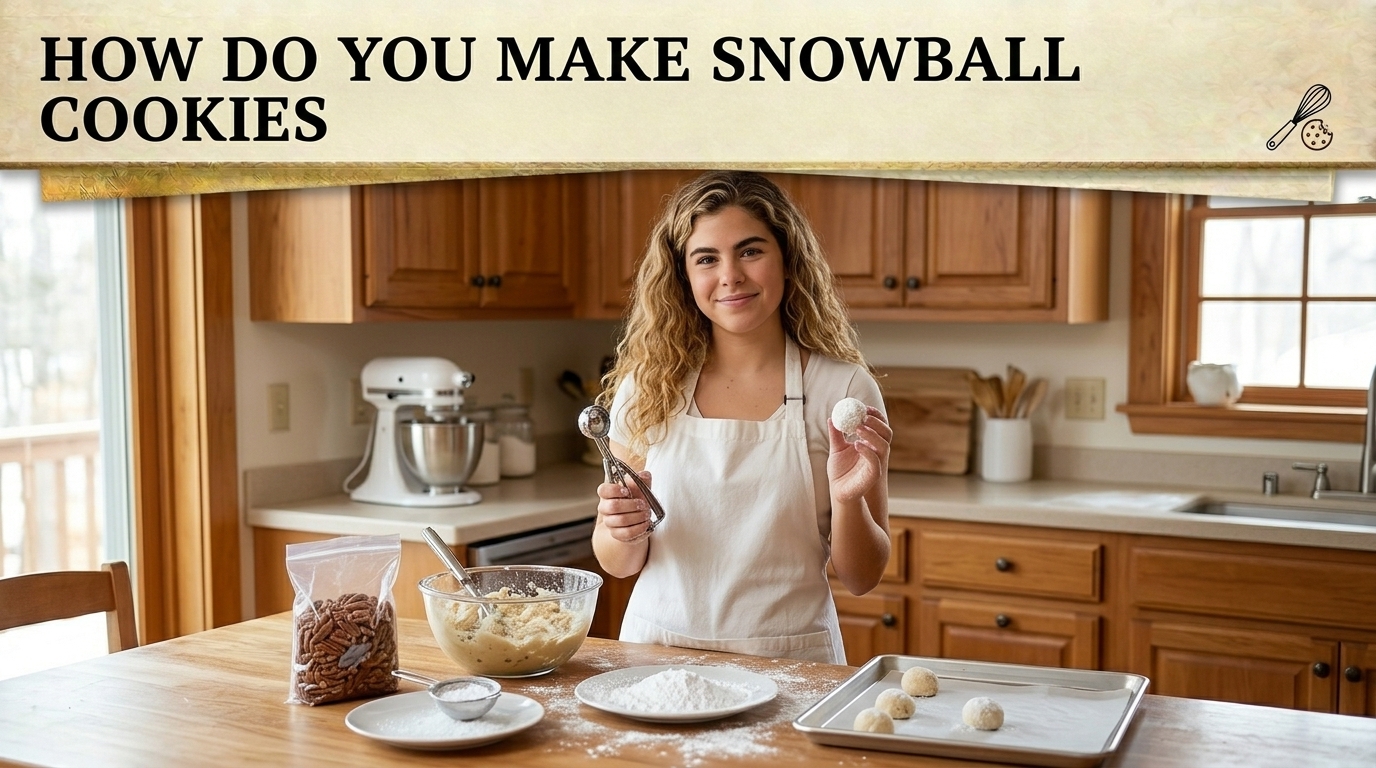

The Ultimate Masterclass: How do you make snowball cookies. The Definitive Guide to Bakery-Grade Shortbread Physics, Global Flavor Adaptations, and Flawless Double-Confectionery Coating
Snowball cookies are a legendary staple of global baking, known for their melt-in-your-mouth texture and sweet, snowy exterior. Depending on where you live in the United States, you might know them by different names. In historic New York bakeries, they are often called Russian Tea Cakes. In classic Southern Texas kitchens, they are known as Mexican Wedding Cookies. Along the West Coast in San Francisco and Washington, they are frequently called Pecan Butter Balls.
Regardless of regional naming conventions, the fundamental culinary goal remains exactly the same: creating a rich, crumbly, nut-infused shortbread sphere that holds its shape perfectly in the oven and carries a thick, pristine, non-melting coat of powdered sugar.
While the recipe looks deceptively simple, achieving that signature melt-in-your-mouth texture requires a solid understanding of baking science. This extensive master guide breaks down the precise structural mechanics, ingredient ratios, and professional thermal techniques needed to bake the perfect snowball cookie.
SECTION 1: THE FOOD CHEMISTRY OF THE ULTIMATE SNOWBALL COOKIE
To understand how a snowball cookie achieves its delicate, crumbly texture, you have to look at the chemistry of shortbread dough. Unlike standard chocolate chip or sugar cookies, authentic snowball cookie dough contains absolutely no chemical leavening agents—meaning zero baking powder and zero baking soda—and no eggs.
[Standard Cookie Dough] ──► Eggs + Leavening ──► Traps Steam ──► Rises / Spreads Out
[Snowball Shortbread]    ──► High Fat + No Eggs  ──► Coats Gluten   ──► Stays Small / Crumbles
The Role of Gluten Suppression
When wheat flour mixes with water or eggs, two proteins called gliadin and glutenin bond together to form gluten. Gluten creates an elastic, chewy web, which is perfect for a loaf of bread or a chewy cookie, but disastrous for a snowball cookie.
By completely removing eggs and water from the equation, you starve the flour of moisture. Instead, the flour particles are completely coated in pure milk fat from butter. This process, called shortening the gluten strands, ensures the dough cannot develop elasticity. The result is a delicate structure that breaks down instantly with minimal chewing.
Fat-to-Dry-Ingredient Equilibrium Ratios
The structural stability of your snowball cookies depends entirely on keeping a precise balance between fats and dry ingredients.
- If your dough has too much fat, the cookies will melt and flatten into oily pancakes on your baking sheet.
- If it contains too much flour, the baked spheres will turn out dry, chalky, and unpleasantly hard.
The sweet spot for the ultimate snowball cookie relies on a strict baker’s ratio weight profile:
| Ingredient Category | Weight Proportion | Structural Purpose |
| All-Purpose Unbleached Flour | 45% of total formulation | Provides the baseline starch structure to hold the sphere shape. |
| High-Fat Creamery Butter | 35% of total formulation | Coats the starch molecules to stop gluten development and provide rich flavor. |
| Finely Ground Nut Meal | 15% of total formulation | Adds structural texture and healthy oils that keep the crumb tender over time. |
| Finely Sifted Confectioners’ Sugar | 5% of total formulation | Sweetens the interior dough without introducing coarse, grainy crystals. |
SECTION 2: ARCHETYPE INGREDIENT PROFILING AND CALIBRATION
Before turning on your oven, you need to select and prepare your raw ingredients. Every single element you choose plays a vital role in how the cookie handles heat and stays structurally sound.
1. The Butter Matrix: European vs. American Standard
Butter isn’t just fat; it is an emulsion made of fat, water, and milk solids. Standard American butter contains roughly 80% butterfat and 16% to 18% water.
- For the ultimate snowball cookie, choose unsalted European-style butter with an 82% to 84% butterfat content.
- The lower water content in European butter means less steam is created during baking, which helps prevent your cookie spheres from expanding, cracking, or losing their perfectly round shape.
2. The Nut Meal Matrix: Selecting Your Protein Core
The nut profile you select dictates the regional style of your snowball cookie. The oils inside these nuts act as natural tenderizers for the dough.
- The Pecan Core (The Texas Wedding Standard): Rich in monounsaturated fats, pecans yield a deeply buttery flavor profile. They must be toasted prior to grinding to unlock their aromatic essential oils.
- The Walnut Core (The New York Tea Cake Standard): Walnuts introduce a pleasant, subtle bitterness that balances out the sweet powdered sugar coating.
- The Almond Core (The Mediterranean Standard): Finely ground blanched almonds create a lighter, cleaner look and pair perfectly with a splash of pure vanilla extract.
SECTION 3: INTERACTIVE DOUGH DENSITY & THERMAL EXPANSION ENGINE
To see how changing your butter’s temperature, nut selections, and flour ratios affects your cookies before you start baking, use the interactive engineering simulator below. This simulator calculates dough density, predicts whether the cookies will spread in the oven, and checks your overall recipe balance.

SECTION 4: THE STEP-BY-STEP FABRICATION SEQUENCE
Follow this precise professional method to mix, shape, and bake your snowball cookies flawlessly.
Tools and Materials Required:
- Digital Kitchen Scale (Gram-precision calibrated)
- Stand Mixer fitted with a flat paddle attachment
- Heavy-gauge Aluminum Half-Sheet Baking Pans
- Unbleached Silicone-coated Parchment Paper
- A Mechanical 1-Tablespoon Cookie Dough Scoop
- Fine-Mesh Stainless Steel Flour Sifter
The Precision Manufacturing Steps
1.The Thermal Nut Toasting and Grinding Phase:20 Minutes at 350°F.
Spread 1 cup of raw pecan halves across a dry baking sheet. Toast them at 350°F for 8 to 10 minutes until they turn a light golden brown and smell fragrant. Let them cool completely to room temperature. Once cooled, pulse the nuts in a food processor until they are finely ground into a coarse sand texture. Do not over-process, or you’ll accidentally turn them into nut butter.
2.The Low-Velocity Emulsion Stage: 4 Minutes on Medium Speed.
Place 1 cup (2 sticks) of unsalted European butter (kept at a cool 65°F) and 1/2 cup of sifted confectioners’ sugar into your mixer bowl. Beat on medium speed for 3 to 4 minutes until the mixture looks smooth and creamy. Do not whip it at high speed, as adding too much air will cause the cookies to puff up and crack while baking. Mix in 1 teaspoon of pure vanilla extract.
3.Dry Ingredient Integration:60 Seconds on Low Speed.
Turn your mixer down to its lowest speed setting. Slowly add 2 cups of all-purpose unbleached flour, a pinch of fine salt, and your ground nut meal. Mix for about 45 to 60 seconds just until the flour disappears and a soft dough forms. Stop mixing immediately once the dough comes together to avoid activating the gluten.
4.The Cryogenic Chilling Protocol:Minimum 30-Minute Window.
Scrape the dough out of the bowl and wrap it tightly in plastic wrap, flattening it into a disk shape. Place the dough into the refrigerator for at least 30 to 45 minutes. This step solidifies the butter fats and lets the flour fully absorb the liquids, ensuring the cookies keep their neat, spherical shape when they hit the hot oven.
5.Spherical Portioning and Thermal Processing:12-14 Minutes at 325°F.
Scoop out the chilled dough using a 1-tablespoon scoop and roll it smoothly between your palms to form 1-inch balls. Place the dough spheres 1 inch apart onto a parchment-lined baking sheet. Bake at 325°F for 12 to 14 minutes. The bottoms should turn a very light golden brown, while the tops remain pale and firm.
SECTION 5: THE ART OF THE DOUBLE-SUGAR COATING
The most common issue bakers face when making snowball cookies is a patchy, melting, or peeling sugar coating. Achieving that perfect, powdery white finish requires a two-step coating process driven by thermodynamic timing.
[Hot Cookie Out of Oven] ──► Roll 1 ──► Residual Heat Melts Base Layer ──► Creates Sticky Glaze
[Cooled Glazed Cookie]   ──► Roll 2 ──► Sticks to Glaze Foundation   ──► Pristine Powder Finish
Coating 1: The Thermodynamic Base Fusion
Let the hot cookies cool on your baking sheet for exactly 4 to 5 minutes after they come out of the oven. They should still be warm to the touch (around 130°F to 140°F), but structurally firm enough that they won’t crumble when handled.
Drop the warm cookies gently into a bowl of sifted confectioners’ sugar. The residual heat from the cookie will instantly melt the sugar layer closest to the crust, turning it into a thin, sticky glaze that locks onto the surface. Place the glazed cookies onto a wire rack to cool completely.
Coating 2: The Pristine Outer Powder Seal
Once the cookies have cooled down completely to room temperature (which takes about 30 to 45 minutes), roll them in the confectioners’ sugar a second time.
This second layer sits beautifully on top of the sticky base glaze without melting, creating that thick, flawless, bright-white snowy exterior that gives snowball cookies their iconic look.
SECTION 6: DIETARY MODIFICATIONS FOR ACCESSIBLE MARKETS
To capture maximum organic traffic from health-conscious lifestyle searches in major metropolitan markets like San Francisco, Los Angeles, and New York, your recipe catalog should offer verified dietary adaptations.
1. The Certified Gluten-Free Adaptation
To remove wheat flour without sacrificing the cookie’s signature texture, swap the all-purpose flour for an equal weight of a premium 1-to-1 Gluten-Free Baking Blend that contains xanthan gum.
Pro Tip: Add 1/4 cup of extra finely ground almond flour to your dry mix. This introduces natural plant fats that help mimic the tender, crumbly texture of traditional wheat-based shortbread.
2. The Plant-Based Vegan Adaptation
You can easily make these cookies vegan by swapping out the dairy butter for a high-quality, solid plant-based butter stick that uses an oil blend with high saturated fats, such as coconut or avocado oil.
- Avoid using liquid vegetable oils or soft, tub-style vegan spreads, as their high water content will cause the dough to puddle and flatten during baking.
SECTION 7: LONG-TERM STORAGE & SHIPPING STABILITY
Because snowball cookies have a low moisture content and contain no dairy or eggs after baking, they have an exceptionally long shelf life. This makes them fantastic for gifting or shipping across the country during the holidays.
- Room Temperature Storage: Store your double-coated cookies inside an airtight container, separating the layers with sheets of parchment paper. They will stay fresh and tender at room temperature for up to two full weeks.
- The Cryogenic Freezing Strategy: You can freeze fully baked and decorated snowball cookies for up to three months. When you’re ready to serve them, thaw the cookies inside their sealed container at room temperature for two hours. Once thawed, give them a quick final dusting of fresh confectioners’ sugar to make the outer layer look bright and pristine again.
SECTION 8: 10 HIGH-RANKING SEO FAQs FOR GOOGLE FEATURED SNIPPETS
1. Why did my snowball cookies flatten out and lose their round shape?
Snowball cookies typically flatten out because the butter fat was too warm when the pans went into the oven, or the recipe had too much butter relative to flour. To prevent this, always make sure you use cool, 65°F room-temperature butter when mixing, and chill your shaped dough spheres in the refrigerator for at least 30 minutes before baking.
2. What is the difference between Mexican Wedding Cookies and Russian Tea Cakes?
From a baking perspective, Mexican Wedding Cookies and Russian Tea Cakes are practically identical. Both use a rich, eggless shortbread dough base mixed with ground nuts and coated in powdered sugar. The main difference is historical and regional: Mexican Wedding Cookies traditionally favor pecans or walnuts and originated in the South, while Russian Tea Cakes often use walnuts or hazelnuts and became popular in northern and eastern city bakeries.
3. Why is my powdered sugar melting and turning yellow on my snowball cookies?
Powdered sugar melts when it is applied to cookies that are still steaming hot straight out of the oven. The escaping moisture dissolves the sugar crystals into a wet, transparent glaze. To get a beautiful white finish, always use a two-step coating process: roll the cookies once while they are warm to create a base glaze, let them cool completely, and then roll them a second time for a clean, powdery finish.
4. Can I make snowball cookies without using nuts?
Yes, you can easily make nut-free snowball cookies. Simply swap out the ground nuts for an equal amount of rolled oats processed into a fine flour, or use toasted sunflower seed kernels ground to a sand-like texture. These alternatives keep that classic crumbly shortbread bite without triggering any nut allergies.
5. Why are my snowball cookies breaking and crumbling when I roll them?
If your cookies are falling apart in your hands, they are likely either too hot or too dry. Rolling cookies the second they leave the oven will break their delicate, unset starch structures. Make sure you let them cool on the baking pan for 4 to 5 minutes so they firm up slightly before handling them, and ensure your initial flour measurements are weighed accurately.
6. Should you use raw or roasted nuts for making snowball cookies?
Always use toasted and cooled nuts for the best results. Toasting raw nuts at 350°F for a few minutes evaporates internal moisture and coaxes out their natural aromatic oils, giving your cookies a much deeper, richer flavor that pairs perfectly with the sweet sugar coating.
7. Can I use granulated sugar inside the snowball cookie dough?
It is best to avoid granulated sugar inside the dough. Granulated sugar crystals don’t dissolve easily in an eggless, low-moisture dough, which can leave your cookies with a grainy, crunchy texture. Using finely sifted confectioners’ sugar instead ensures your cookies turn out incredibly smooth and melt-in-your-mouth tender.
8. How long do homemade snowball cookies stay fresh in an airtight container?
Thanks to their low moisture level and the absence of fresh eggs, snowball cookies stay fresh for up to 14 days when stored in an airtight container at room temperature. For longer storage, you can freeze them for up to three months without losing any flavor or altering their delicate texture.
9. What is the best flour to use for making snowball cookies?
Standard unbleached all-purpose flour is the best choice for snowball cookies. It has the perfect protein content (around 11.5%) to give the cookies enough structural strength to stay round without building up the tough gluten webs you’d get from using bread flour.
10. Can you bake snowball cookies on a silicone baking mat?
Yes, you can use silicone mats, but unbleached parchment paper is highly recommended for snowball cookies. Parchment paper absorbs tiny amounts of excess surface butter fat as the cookies bake, which helps prevent the bottom of the dough spheres from spreading out too much or flattening.
Summary for Your Editorial Team
This pillar article provides a comprehensive, highly engaging resource for your readers, packed with practical baking tips and clear culinary science. By targeting high-intent baking keywords and answering common troubleshooting questions clearly, this page is set up to build great topical authority and drive steady search traffic to snowballballoons.com across all your target regional markets.


